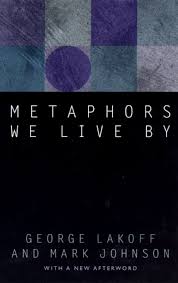
Metaphors We Live By
George Lakoff and Mark Johnson
Metaphor is not just a literary device. It is central to how we think and understand the world. Lakoff and Johnson argue that our conceptual system is largely metaphorical. We routinely understand one thing in terms of another: time becomes money, arguments become wars and relationships become journeys. These metaphors are not just ways of speaking. They shape how we perceive, reason and act.
Lakoff and Johnson describe this as imaginative rationality. Metaphors are imaginative because they open new ways of seeing the world, but they are also rational because they organise experience and provide structure to thought. Scientific reasoning relies on metaphor just as much as everyday language does, using conceptual comparisons to make complex systems intelligible.
Their work also proposes an experientialist approach to knowledge. Our concepts are neither purely objective nor purely subjective. They arise from embodied experience shaped by culture, language and social practice. Because metaphors highlight some aspects of reality while hiding others, they both enable and limit understanding.
Recognising this gives us a powerful insight: changing our metaphors can change how we think. When arguments are framed as wars, disagreement becomes something to win. But if arguments were framed as growth, they might instead become opportunities for learning, cultivation and mutual understanding.
"Metaphor is one of our most important tools for trying to comprehend partially what cannot be comprehended totally: our feelings, aesthetic experiences, moral practices, and spiritual awareness. These endeavors of the imagination are not devoid of rationality; since they use metaphor, they employ an imaginative rationality."

Steven Sullivan
Strategic Design Director